 Loading...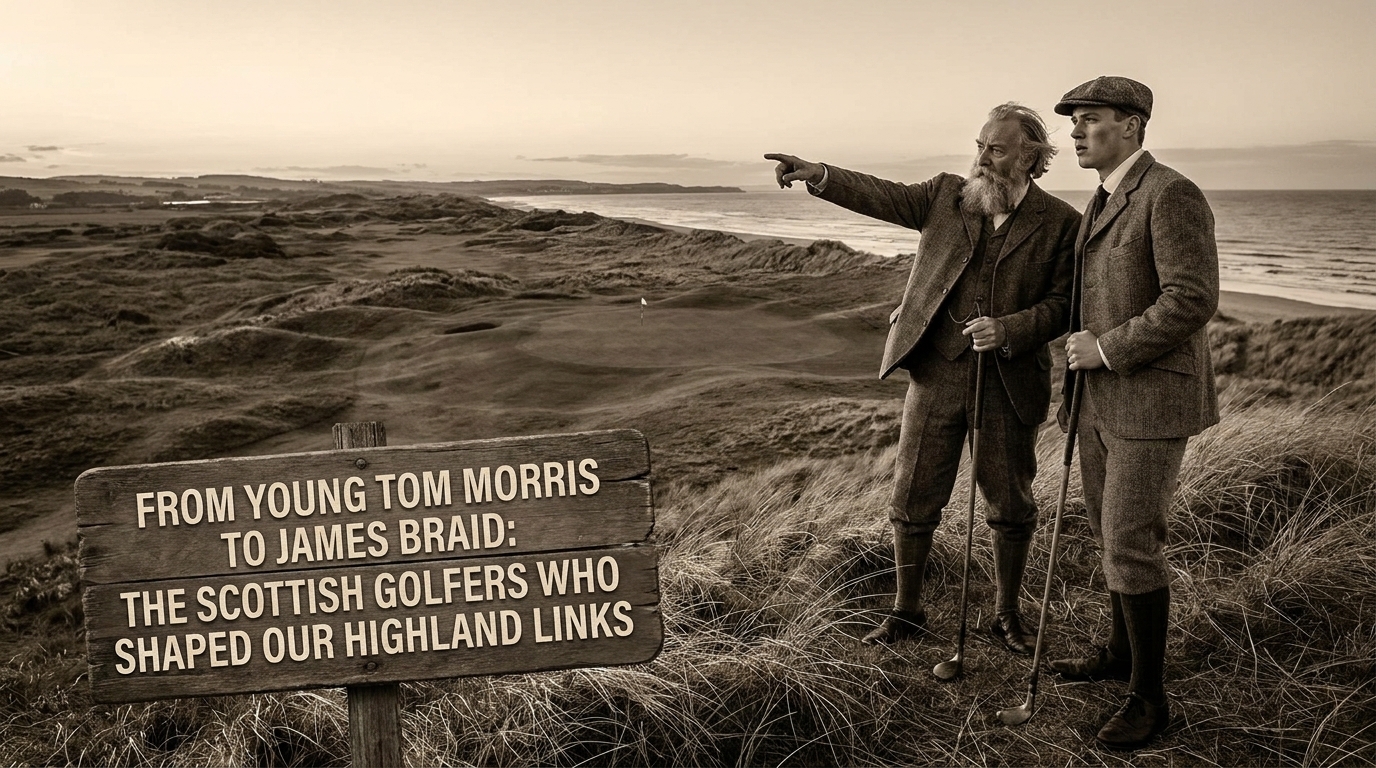
Stand on the first tee at Brora on a bright September morning, wind off the Moray Firth, sheep grazing the fairway, and you're not just starting a round — you're stepping into a line of footprints laid down more than 150 years ago. Every great Scottish golfer, in one way or another, has a hand in the ground beneath your spikes up here. This is the story of how they shaped our Highland links.
Young Tom Morris and the birth of tournament golf
You can't tell the tale of Scottish golf without starting in Fife with the Morrises. Old Tom Morris — greenkeeper, clubmaker, four-time Open Champion — is the man most often credited with turning a rough seaside pastime into an organised sport. His son, Young Tom, took the game and lit it on fire: four Opens in a row between 1868 and 1872, the first ever recorded hole-in-one in Championship play, and a swing his contemporaries described as almost violent in its intent.
Old Tom's fingerprints are all over the Highlands too. He was called north to Royal Dornoch in 1886 to extend the course to 18 holes, working with local hero John Sutherland to shape the routing that visitors from all over the world now queue up to play. When you walk Dornoch's raised greens and tumbling fairways, you're walking a course whose bones were laid by the man who essentially invented modern course design.
James Braid, £25, and a Highland masterpiece
If Old Tom is the grandfather of our links, James Braid is the architect of the Highland ones we love best. Five Open Championships between 1901 and 1910, a member of the "Great Triumvirate" alongside Harry Vardon and J.H. Taylor, and — after his playing days — one of the most prolific and gifted course designers Britain has ever produced.
In 1924, Braid came up to Sutherland and redesigned Brora's 18-hole links. His fee? Twenty-five pounds.
Five-time Open Champion. Twenty-five quid. One of the most natural links courses in the world. That's the deal Brora got in 1924, and we've been enjoying the dividend ever since.
Walk our course today and it's still recognisably Braid's routing — the way the holes fold with the contours instead of fighting them, the small crowned greens that ask you to think before you swing, the electric fences keeping the livestock off the putting surfaces (a Brora peculiarity, but a very Braid-era solution). He didn't stop with us either. His hand shows up at Boat of Garten, at courses across the north, and in the DNA of countless clubs who called him in for a tweak here or a new nine there.
The 1906 match that ties it all together
Four years before his fifth Open win, Braid came to Royal Dornoch for a challenge match against his great rival Harry Vardon — a golden-age fixture we wrote about back in November when Dornoch was again named Scotland's finest course. Vardon, six-time Open Champion, versus Braid, then a three-time champion, on a links most southern golfers had barely heard of. The fact that two of the biggest names in the game travelled that far north in 1906 — no A9, no sleeper trains as we know them — tells you everything about the reputation Dornoch already carried.
That match is the thread. Braid at Dornoch in 1906 as a player. Braid at Brora in 1924 as a designer. Two clubs, twenty miles apart, both stitched into the national story by the same man.
The champions who keep coming back
The pull hasn't faded. In 1995, Peter Thomson — Australian, five-time Open Champion — made the pilgrimage to Brora and delivered the line we've been quietly proud of ever since:
"The most natural links course in the world." — Peter Thomson, 1995
Tom Watson, another five-time Open Champion, liked us enough to become an honorary member. Neither of them is Scottish, of course — but the fact that the men who've hoisted the Claret Jug make a point of coming here, past St Andrews, past Muirfield, past Turnberry, says something about what Braid built and what our members have preserved.
Sandy, Monty, Catriona — and now Bob
The modern Scots keep the line going. Sandy Lyle's 1985 Open at Sandwich and 1988 Masters. Colin Montgomerie's eight European Order of Merit titles and his Ryder Cup captaincy. Catriona Matthew winning the 2009 Women's British Open weeks after giving birth, and then leading Europe to back-to-back Solheim Cup wins. And now Bob MacIntyre, the Oban left-hander who's carrying the tartan on the PGA and DP World tours with the sort of gutsy, weather-hardened game that could only have been forged on Scottish turf.
They're the current chapter. But every one of them learned the same lessons the greats did — that the wind decides, the ground plays half the shots, and a well-designed links, whether it's St Andrews or our own 18 at Brora, will out-think a golfer every time.
Your turn on the same fairways
The best thing about this history? It isn't behind glass. You can walk Old Tom's Dornoch and Braid's Brora next week if you fancy it. The Carnegie Shield is still being contested — Jack Peters lifted the 112th edition in September — and the fixture card is full through the season. These are living, breathing clubs, not museum pieces.
If you're planning a Highland trip, do it properly: Dornoch and Brora on back-to-back days, a dram at Clynelish in the evening, and you'll understand more about Scottish golf than any book can teach you.
Enjoyed this? We're putting together a free Highlands golf trip planner — the courses to play, the order to play them in, where to eat and where to stay. Subscribe to the newsletter and we'll send it straight to your inbox, along with our weekly notes from the pro's chair.
And come say hello on Instagram — we post course conditions, sunrise shots from the first tee, and the odd member's medal drama. Follow along, and drop a comment below with the Scottish golfer you'd have added to the list.
Leave a Comment